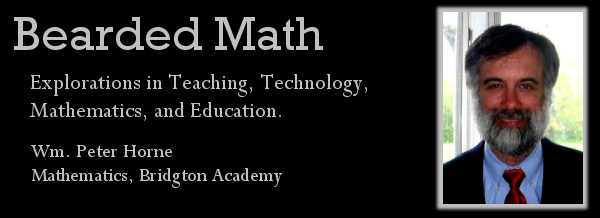
Bearded people tend to evoke reactions in others. Some may recall the pleasant times around Christmas, and the joy of Santa Claus. Other people may picture a sage ready to impart truth or wisdom, such as Solomon or Lincoln. Others may envision a wizard possessing arcane knowledge, inaccessible to others, such as Merlin or Gandalf. For some, the sight of a beard produces fear or mistrust as they imagine Satan or Bin Laden. A bearded person chooses to make a bold statement to the world. In today’s society beards challenge convention; they force people to look at something that is different from the norm, and they disrupt the status quo.
So it is with mathematics. People tend to either enjoy math and see the possibilities in the numbers and equations, or they look for any way possible to avoid it. This polarization is even more apparent when people face higher mathematics such as Probability and Statistics, Calculus, or Differential Equations. As a math teacher, I see this polarization everyday. Those students who enjoy mathematics will diligently do their work, grasp new concepts relatively easily, and continue to make steady progress. The remainder will shuffle in, already convinced that the concepts will be beyond their understanding, and hoping they will survive the class. My task is to provide bearded math to confront the preconceptions of those who seek to avoid math.
The first day of class can often set the stage for the remainder of the year. Many students nervously shuffle into my class, dreading another foray into mathematics. Some have had any enthusiasm for the subject “drilled and killed.” Others have consistently struggled and can’t understand why they can’t comprehend the material. More often, I see the students who spent high school filling space for the required time and hoped to learn through osmosis rather than effort on their part. For all of these students, before I write anything else on the board, I inform the class that there is one particular rule they must follow for the entire year if they are going to succeed in my class. With a bit of flourish and over dramatization I write in large, capital letters, two words:
DON’T PANIC!
Hopefully, this is not what they were expecting. I find that if my students are more relaxed about being in class, they are more receptive to learning. Furthermore, if I can catch them a bit off guard, they are more eager to discover what comes next. With that, the first few whiskers of bearded math begin to sprout.
Peter Horne has taught both mathematics and computer science, and he has coached golf, skiing, and cross-country teams at Bridgton. Currently Peter teaches Calculus and Pre-Calculus, and he coaches the golf team. Peter earned his Bachelor of Aerospace Engineering from Georgia Institute of Technology, and he earned an appointment as Lecturer of Mathematics from the University of Southern Maine. Peter lives midway between Bridgton Academy and the golf course, which he rarely visits, because of his busy life off-campus. Peter and his wife, Laurie, are the parents of seven children ranging in age from four to twenty-one. In his free moments, Peter enjoys reading, cooking, golf, and spending time with his family.
